
Glass vs. Polycarbonate: Which Sunroom Roof Performs Better in Europe?
For most European sunrooms, neither glass nor polycarbonate is automatically the best roof material. The right choice depends on the local climate, orientation, roof pitch, frame system, ventilation strategy, desired daylight, budget, and whether the room is used year-round. High-performance insulating glass usually offers the clearest appearance, the best visual connection to the outdoors, and strong long-term design value. Multiwall polycarbonate is lighter, more impact-tolerant, and often easier to install, while its cellular structure can provide useful thermal insulation at a lower initial cost.
A cold northern climate may prioritize winter heat retention and snow performance. A southern or continental climate may need stronger solar control and ventilation to prevent overheating. Coastal areas add wind, salt, and driving rain, while alpine regions bring snow loads, freeze-thaw cycles, and hail exposure. The material decision should therefore be made as part of a complete roof assembly rather than by comparing a single glass or sheet specification.
This guide compares the two options across thermal performance, daylight, solar gain, durability, structure, installation, appearance, maintenance, and lifecycle value.
How Do Glass and Polycarbonate Roof Systems Differ?
Roof glazing is normally made from laminated, toughened, or insulating glass units. A modern roof may use double or triple insulating glass with low-emissivity coatings, inert-gas cavities, warm-edge spacers, and solar-control layers. The performance of the roof depends on the glass build-up, frame, seals, edge details, roof pitch, shading, and ventilation.
Polycarbonate roofing is available as solid sheets or multiwall sheets. Solid polycarbonate is relatively clear and impact resistant, while multiwall polycarbonate contains internal ribs or chambers that reduce weight and improve insulation. Twinwall, triplewall, honeycomb, and more complex cellular profiles can provide different combinations of light transmission, stiffness, condensation control, and thermal performance.
This distinction matters because “polycarbonate roof” can describe very different products. A thin corrugated sheet over a lightly used seasonal enclosure should not be compared directly with a high-performance multiwall system designed for an occupied room. Similarly, ordinary single glazing is not a fair benchmark for a properly specified low-emissivity insulating glass roof.
The frame is equally important. A high-performing panel installed in a thermally weak aluminum frame may deliver disappointing comfort. Thermal bridges at rafters, gaskets, perimeter junctions, roof vents, and wall connections can dominate the performance of the entire sunroom.
Which Material Provides Better Winter Thermal Performance?
Winter comfort is often the decisive issue in northern and central Europe. Heat loss through a roof is influenced by the panel’s thermal transmittance, the frame, the size and shape of the roof, air leakage, shading, and the connection to the existing building. Lower thermal transmittance generally means less heat passes through the roof, but the declared value must relate to the complete system and its installation conditions.
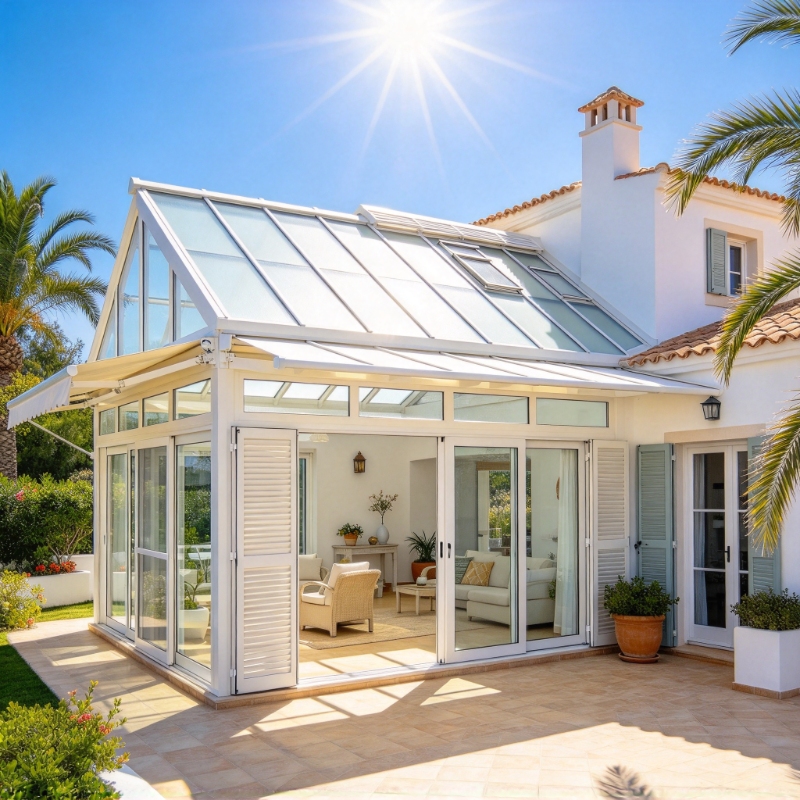
Insulating glass can perform very well when it uses two or three panes, low-emissivity coatings, a suitable cavity, warm-edge spacers, and thermally improved frames. The European standard EN ISO 10077-1 provides methods for calculating the thermal transmittance of windows and pedestrian doors containing glazed or opaque panels. For a sunroom, the design team should consider the roof unit, frame, edge spacer, rafters, and junctions rather than quoting the center-of-glass value alone.
Multiwall polycarbonate can also provide useful insulation because its internal chambers reduce direct heat transfer. Manufacturers commonly offer several sheet structures and light-transmission levels, allowing the designer to balance daylight against heat retention. The actual result depends on sheet thickness, cell geometry, edge sealing, support spacing, frame design, and the quality of the installation.
Glass may deliver a more stable, premium year-round envelope when correctly specified, particularly for a heated extension that forms part of the home’s main living space. Polycarbonate can be highly practical for a lighter sunroom or conservatory, but the selected product must be checked for condensation, aging, acoustic comfort, and long-term flatness.
Which Roof Controls Summer Overheating More Effectively?
A transparent roof can create a greenhouse effect in any European climate. Even in a cool country, a south-facing or west-facing sunroom can become uncomfortable on sunny days. Solar-control glass can reduce solar transmission while preserving useful daylight. External shading, roof vents, opening windows, blinds, and mechanical ventilation are also important because no transparent roof material can solve overheating on its own.
Glass offers precise control over visible light and solar energy when the correct coating and tint are selected. Low-emissivity glass is primarily associated with reducing long-wave heat loss, while solar-control coatings can limit solar heat entering the room. These functions should be evaluated separately. A highly reflective glass may reduce heat but produce a darker interior or a different exterior appearance than the client expects.
Polycarbonate is available in clear, opal, tinted, embossed, and reflective forms. Diffusing or opal sheets can distribute daylight more evenly and reduce harsh patches of sun. Some products offer solar-control or infrared-management properties. However, the designer should review the product’s light-transmission and solar-energy data rather than assuming that a darker sheet will always create better comfort.
The most effective strategy combines material selection with orientation-specific design. A south or southwest roof may require external shading and controlled ventilation. East and west roofs can receive low-angle sunlight that is difficult to block with internal blinds. Roof openings, ridge vents, automated shades, and temperature sensors may provide more comfort than changing from one transparent material to another.
How Do Daylight, Views, and Visual Quality Compare?
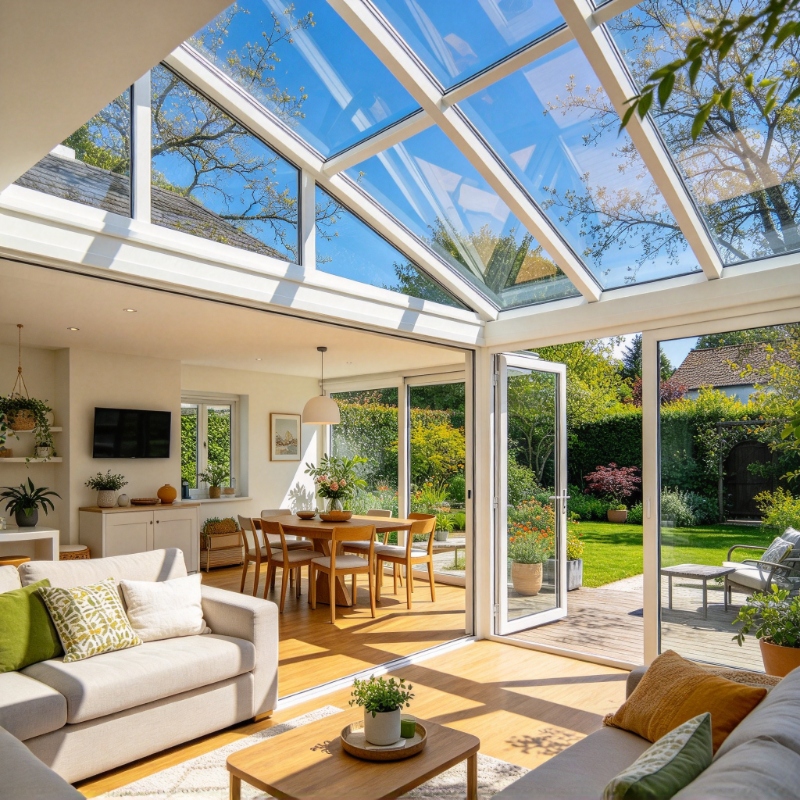
Glass is usually preferred when the main objective is a clear, uninterrupted view of the garden, sky, or surrounding landscape. High-quality insulating glass can create a bright architectural extension with minimal visual distortion. It also works well when the sunroom is intended to feel like a permanent part of the house rather than a seasonal enclosure.
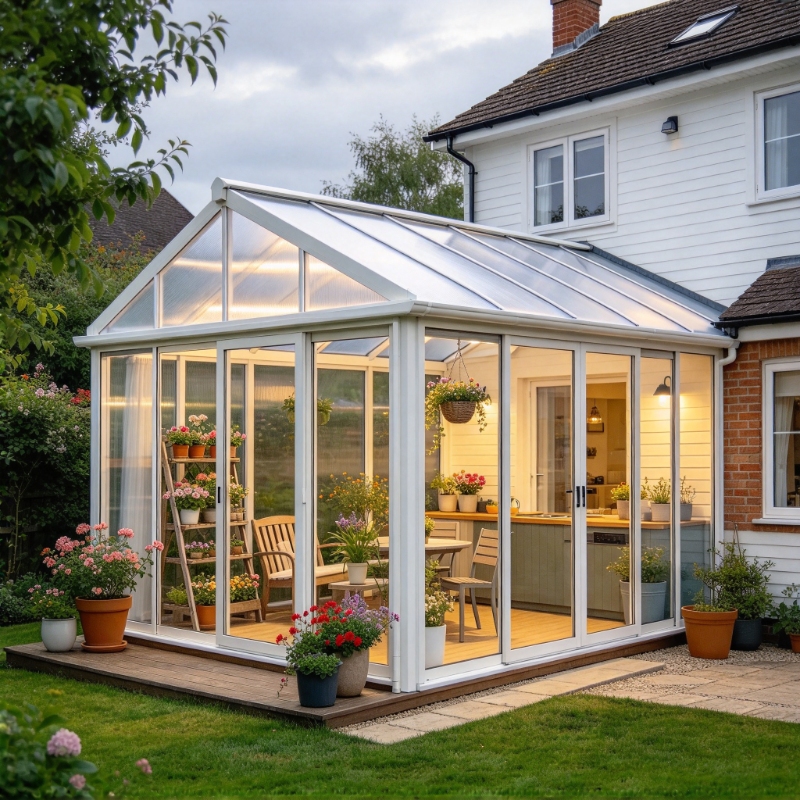
Polycarbonate provides a softer and more diffused daylight effect, especially in opal or multiwall products. The internal structure can make the material visibly different from glass, with lines, ribs, or a subtle texture across the roof. Some homeowners appreciate the even light and reduced glare, while others prefer the transparency and visual clarity of glass.
Clear polycarbonate may gradually show surface wear, dirt, or optical change depending on its UV protection, cleaning method, exposure, and product quality. Glass can also stain or scratch, but it generally retains a more stable visual character when properly maintained. Laminated or patterned glass can add privacy, solar control, or decorative value without introducing the cellular appearance of multiwall sheet.
The choice should be tested at full scale. A small sample viewed indoors cannot show how roof ribs, reflections, tint, frame shadows, rain marks, and seasonal sunlight will affect the room. Ask for a sample panel or mock-up in the intended frame and review it from inside and outside.
Which Material Is Stronger for Wind, Snow, and Hail?
Structural performance depends on the roof geometry and support system as much as the transparent material. Wind creates both pressure and suction, while snow creates a sustained downward load that can be uneven when drifting occurs near walls, parapets, or higher roof sections. Local building regulations determine the design loads, and a conservatory roof should not be treated as a simple lightweight cover without checking the structure.
Glass is heavy, which increases the demand on rafters, beams, foundations, and connections. That weight can also contribute to a solid, stable feel, but it requires careful handling during delivery and installation. Laminated or toughened glass may be selected for safety and overhead applications, with the build-up determined by the project requirements.
Polycarbonate is much lighter and can reduce the load on a retrofit structure. Multiwall sheets can be cut and handled more easily, but their allowable span and fixing pattern must be respected. Excessive spacing between rafters can lead to deflection, vibration, ponding, or connection stress. Sheets also need correct orientation, edge closure, washers, expansion allowance, and compatible profiles.
Hail resistance depends on the product, thickness, surface protection, impact rating, roof pitch, and local exposure. Do not assume that all polycarbonate is hail-proof or that all glass performs identically. Request tested product data for the actual sheet or glass build-up and consider the cost and practicality of replacing a damaged roof panel.
How Do Installation and Maintenance Requirements Compare?
Glass installation usually requires more planning, specialist handling, stronger lifting equipment, and careful protection of edges and coatings. Insulating glass units must be supported correctly, kept square, and sealed into a compatible frame. Drainage paths and pressure plates should be detailed so that water does not remain at the edge seal or enter the roof assembly.
Polycarbonate sheets are lighter and may reduce installation time, especially on small residential projects. Nevertheless, installation quality remains critical. Multiwall sheets need proper closure tapes or profiles, compatible connectors, movement allowance, UV-protected faces oriented correctly, and drainage details that prevent insects, dirt, and condensation from entering the chambers.
Glass is usually cleaned with standard glazing methods, although coated products may have restrictions on abrasive tools and chemical cleaners. Polycarbonate can scratch more easily, so it should be cleaned with soft materials and approved solutions. Aggressive solvents, rough brushes, and dry wiping can damage the surface or reduce optical quality.
Both systems need periodic inspection. Check seals, flashings, gutters, roof vents, fasteners, panel movement, condensation, algae, blocked drainage, and signs of frame corrosion. After severe storms, inspect for impact damage and loosened components. A maintenance plan should include safe roof access and a method for replacing individual panels without damaging adjacent units.
What Are the Cost and Lifecycle Considerations?
Initial price is only one part of the decision. Glass may have a higher material, frame, transport, and installation cost, particularly when the roof uses large triple-glazed units, specialty coatings, laminated safety glass, or complex shapes. Polycarbonate may reduce material and labor costs because it is lighter and easier to cut, but higher-performance multiwall products, specialized profiles, replacement stock, and eventual panel changes must be included.
A lifecycle comparison should examine winter heating demand, summer cooling or shading, cleaning, repairs, condensation control, expected appearance, acoustic comfort, and service access. If the sunroom is used every day as a dining room or home office, better thermal stability and visual quality may justify the investment in high-performance insulating glass. If it is a lighter seasonal space, a good multiwall polycarbonate system may offer a sensible balance of cost, daylight, and insulation.
Environmental assessment should include the complete assembly: frame material, coatings, sealants, transport, replacement frequency, recyclability, and end-of-life separation. The European Union’s Energy Performance of Buildings framework emphasizes improving building energy performance and moving toward a decarbonized building stock. A sunroom roof should therefore be considered in relation to the existing building’s heating, cooling, ventilation, and solar strategy rather than evaluated as an isolated product.
Which Roof Is Better for Different European Climate Zones?
In cool and wet northern regions, prioritize insulating performance, airtight frames, drainage, condensation control, and low-maintenance detailing. High-performance double or triple glazing may be attractive for a heated extension, while a thermally efficient multiwall polycarbonate system can work well where lower weight and diffused light are priorities.
In oceanic western regions, wind-driven rain, moisture, corrosion, and changing temperatures require robust seals, drainage, compatible fasteners, and regular inspection. Both materials can work if the roof pitch, flashing, and wall junctions are carefully designed.
In continental climates, large seasonal temperature swings make movement joints, ventilation, solar control, and frame detailing especially important. A roof that performs well in winter can still overheat in summer if shading and ventilation are ignored.
In Mediterranean and warmer southern regions, solar gain is often the main concern. Select solar-control glass or a suitable polycarbonate sheet, and combine it with external shading, cross-ventilation, roof vents, and light-colored surrounding surfaces. In alpine or high-altitude areas, snow, wind, hail, and freeze-thaw conditions may favor a structurally engineered system with strong support spacing and easy access for inspection.
Final Decision Checklist and FAQ
Before choosing glass or polycarbonate, answer these questions:
Will the sunroom be heated and occupied throughout the year?
Which roof orientation receives the strongest summer sun?
What are the local wind, snow, hail, and rainfall conditions?
Is the existing structure strong enough for the selected roof weight?
What level of view clarity, privacy, glare control, and daylight diffusion is preferred?
How will the room be ventilated and shaded during heat waves?
Can the roof be cleaned and individual panels replaced safely?
Do the complete assembly and frame meet local building and energy requirements?
Is glass always warmer than polycarbonate?
No. Performance depends on the exact build-up. High-performance insulating glass can be very efficient, while well-designed multiwall polycarbonate can provide useful insulation. Compare declared system values, frame details, air leakage, and junctions rather than the material name alone.
Is polycarbonate better for heavy snow?
Not automatically. Its low weight can benefit a lighter structure, but span limits, support spacing, snow loads, and fixing details must be engineered. Glass roofs also require structural design because of their weight and overhead safety requirements.
Which material lasts longer?
Service life depends on product quality, UV protection or coating, installation, cleaning, drainage, impact exposure, and maintenance. Request manufacturer warranties and technical data for the specific product and climate.
What is the best choice for a year-round sunroom?
A properly designed insulating-glass roof is often attractive for a year-round living extension because it offers clear views and precise thermal and solar-control options. A high-quality multiwall polycarbonate system may also be appropriate where lower weight, diffused light, and budget control are more important.
Can glass and polycarbonate be combined?
Yes. Some designs use glass in key view zones and polycarbonate in less visible roof areas, or combine transparent panels with opaque insulated sections and external shading. The junctions must accommodate different movement, thicknesses, support methods, and maintenance needs.
Conclusion
For a European sunroom, the best roof material is the one that matches the climate, occupancy, orientation, structure, and comfort target. Glass offers clear views, stable visual quality, and sophisticated insulating and solar-control options. Polycarbonate offers low weight, impact tolerance, diffused daylight, and a potentially more accessible installation cost.
Neither option should be specified from a sample or price alone. Compare the complete roof assembly, including frame, seals, drainage, ventilation, shading, structural support, fire and safety requirements, and maintenance access. Use current product data and local design loads, then review a full-size sample or mock-up before ordering. A carefully coordinated system will deliver better comfort, lower avoidable energy use, and a longer service life than a material choice made in isolation.
As a practical rule, choose high-performance insulating glass when uninterrupted views, year-round occupancy, premium appearance, and precise solar-control options are the main priorities. Choose a properly engineered multiwall polycarbonate system when low structural weight, diffused light, impact tolerance, faster handling, or budget control has greater importance. In both cases, invest in shading and ventilation early: preventing summer overheating is usually a whole-roof design task, not a simple consequence of choosing one transparent material. A climate-responsive design will make the sunroom more comfortable in winter, safer during severe weather, and more useful throughout the year.