
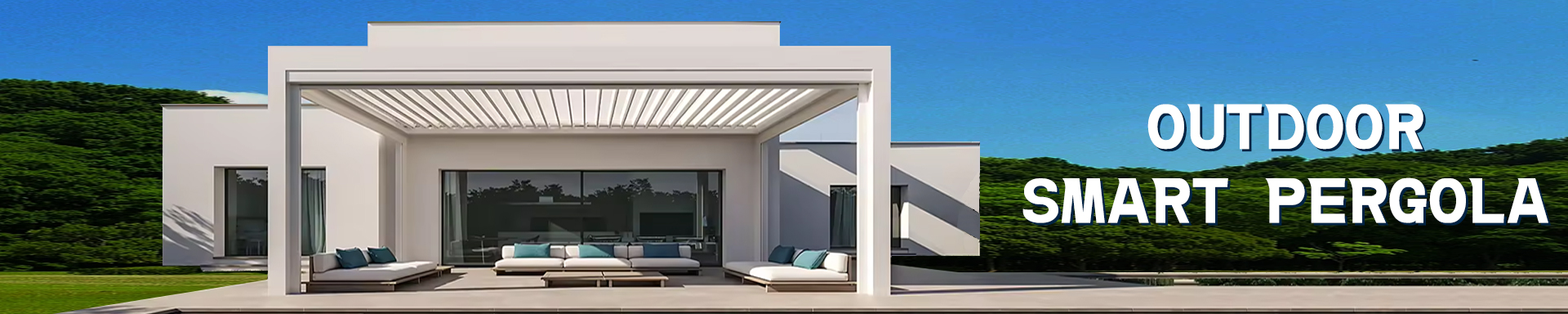
1. Verify the Supplier’s Manufacturing Capability
When selecting a supplier, manufacturing capability is not a vague concept—it determines whether a louvered pergola system can be produced accurately, delivered consistently, and adjusted when real-world site conditions change. Suppliers that control their own production lines can align design intent with structural execution, which is critical for outdoor structures exposed to wind, rain, and daily operation.
A supplier producing complete louvered pergola systems internally typically maintains tighter tolerances on blade alignment, drainage paths, and frame geometry than those relying on external factories.
In practical construction environments, even minor deviations—such as roof pitch or column spacing—can cause installation delays. Manufacturing control eliminates those risks at the source, not after problems appear on site.
1.1 In-House Production vs Outsourced Manufacturing
Suppliers with in-house manufacturing manage aluminum processing, surface treatment, and final assembly within one workflow. This structure allows engineers to respond immediately when drawings require adjustment.
In one residential upgrade involving an aluminum pergola house, the project team discovered that the existing patio slab had a slight slope variation. Because the manufacturer handled production directly, column heights and louver spacing were recalculated before fabrication, ensuring smooth installation without on-site modification.
Outsourced suppliers, by contrast, depend on third-party factories. Communication often passes through multiple layers, increasing the risk of misinterpretation. Design changes may require re-quoting or extended lead times, especially for custom dimensions.
| Comparison Aspect | In-House Manufacturer | Outsourced Supplier |
|---|---|---|
| Design Adjustment Speed | Immediate engineering response | Delayed factory feedback |
| Custom Dimension Control | Fully supported | Often restricted |
| Responsibility for Errors | Direct and traceable | Shared or unclear |
| Production Consistency | Stable across batches | Variable |
This difference becomes more visible as project complexity increases, particularly for multi-unit outdoor developments.
1.2 Factory Scale, Equipment, and Output Capacity
Manufacturing capability also depends on whether a supplier’s facility can sustain volume without sacrificing precision. Projects such as multi-zone hospitality terraces or residential compounds using aluminum pergola structures require consistent output across all units.
Suppliers producing aluminum motorized pergola systems typically operate dedicated assembly lines for motor integration, ensuring synchronized blade movement and reliable long-term operation.
A capable factory usually maintains separate zones for cutting, coating, and assembly. This separation prevents cross-contamination in finishes and allows parallel production schedules. When suppliers hesitate to disclose equipment types or monthly output, it often indicates limited scalability rather than confidentiality.
1.3 Quality Control Process for Louvered Pergola Systems
Reliable manufacturers embed quality control into production, not just at the final inspection stage. This approach is essential for moving structures such as aluminum automated pergola systems, where mechanical accuracy affects daily usability.
A standard control process usually includes material verification, pre-assembly testing of louvers, drainage validation, and motor load testing under simulated conditions.
In commercial settings—such as restaurants installing adjustable outdoor covers—these checks prevent operational failures during peak usage. Suppliers producing Aluminum Modern Gazebo structures often apply similar protocols, as both systems rely on precise load distribution and weather resistance.
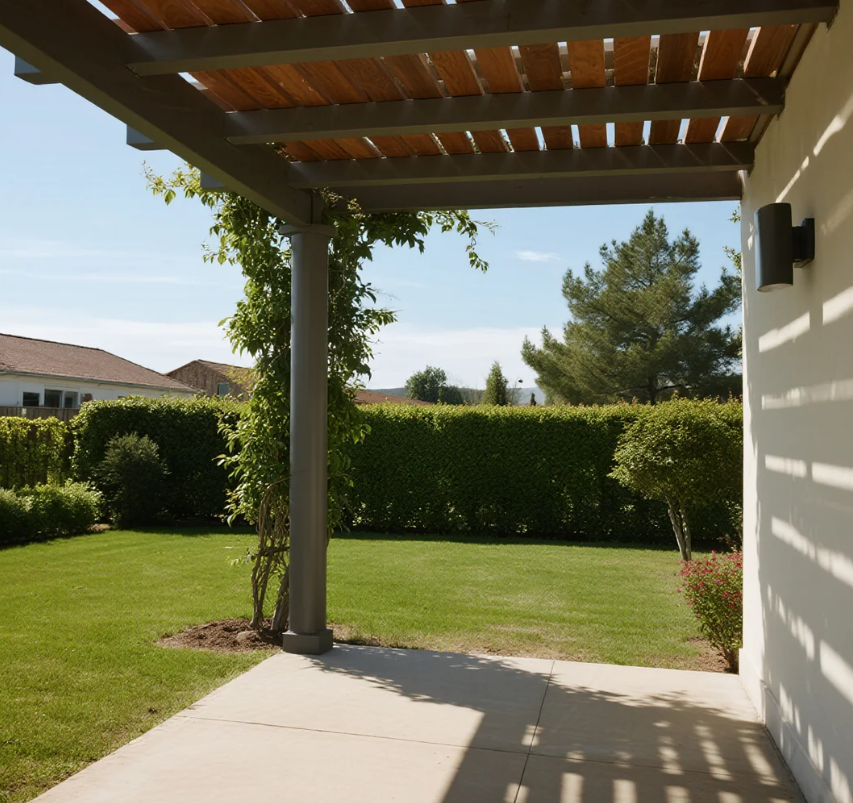
2. Evaluate Product Specifications and System Performance
Once manufacturing capability is confirmed, the next decisive factor lies in how the product actually performs in real outdoor conditions. Evaluating specifications and system performance goes beyond catalog descriptions—it requires understanding how materials, structure, and control systems work together in a finished louvered pergola installation. Performance issues rarely come from a single component; they usually result from mismatched specifications across the system.
2.1 Material Standards for Aluminum Louvered Pergola Structures
Material quality defines the baseline performance of any pergola system. Reputable suppliers typically use structural-grade aluminum alloys such as 6063-T5 or 6061-T6, selected for their balance between tensile strength, corrosion resistance, and machinability. In coastal or high-humidity environments, surface treatment matters just as much as alloy choice. Powder coating thickness, pretreatment methods, and curing consistency directly affect long-term appearance and resistance to oxidation.
In practical residential projects, such as a backyard installation connected to an aluminum pergola house extension, inconsistent coating thickness often leads to visible color variation after one or two seasons. Reliable suppliers avoid this by controlling coating parameters across batches rather than adjusting them order by order.
Material transparency is a strong indicator of supplier confidence. Suppliers who clearly specify alloy grades, wall thickness, and coating standards usually maintain stable sourcing and repeatable production processes.
2.2 Structural Strength, Wind Load, and Drainage Design
Structural performance determines whether a pergola functions reliably under real weather conditions. A well-designed system distributes loads through columns, beams, and louvers without creating stress concentration points. Wind load ratings typically range from moderate residential levels to higher commercial requirements, depending on column spacing and beam reinforcement.
Drainage design often separates average systems from well-engineered ones. Integrated gutter channels and internal downspouts allow rainwater to exit through columns rather than external add-ons. In regions with sudden heavy rainfall, this design prevents overflow and splashback near seating or doorways.
During installation, structural alignment follows a clear sequence:
-
Verify foundation level within a tolerance of 3–5 mm across the footprint
-
Anchor columns according to specified embed depth and spacing
-
Install beams before louvers to maintain structural square
-
Test drainage flow before final motor or blade calibration
Suppliers who can explain these steps clearly usually understand how their structures behave on site, not just on paper.
2.3 Motorized, Manual, and Smart Control System Options
Control systems influence both usability and long-term maintenance. Manual systems rely on mechanical linkages and suit smaller installations with limited daily adjustments. Motorized systems, including advanced aluminum motorized pergola configurations, integrate tubular motors calibrated to blade weight and span length, ensuring smooth and synchronized movement.
Smart control options add weather sensors, remote access, and automation logic. These systems adjust louver angles based on sunlight or rainfall, reducing manual intervention. However, system reliability depends on proper motor selection, wiring layout, and control box protection rather than software features alone.
A reliable supplier matches control systems to structural size and usage frequency, instead of promoting one solution for all projects. When suppliers discuss torque values, duty cycles, and replacement accessibility in detail, it usually reflects real installation experience rather than theoretical knowledge.
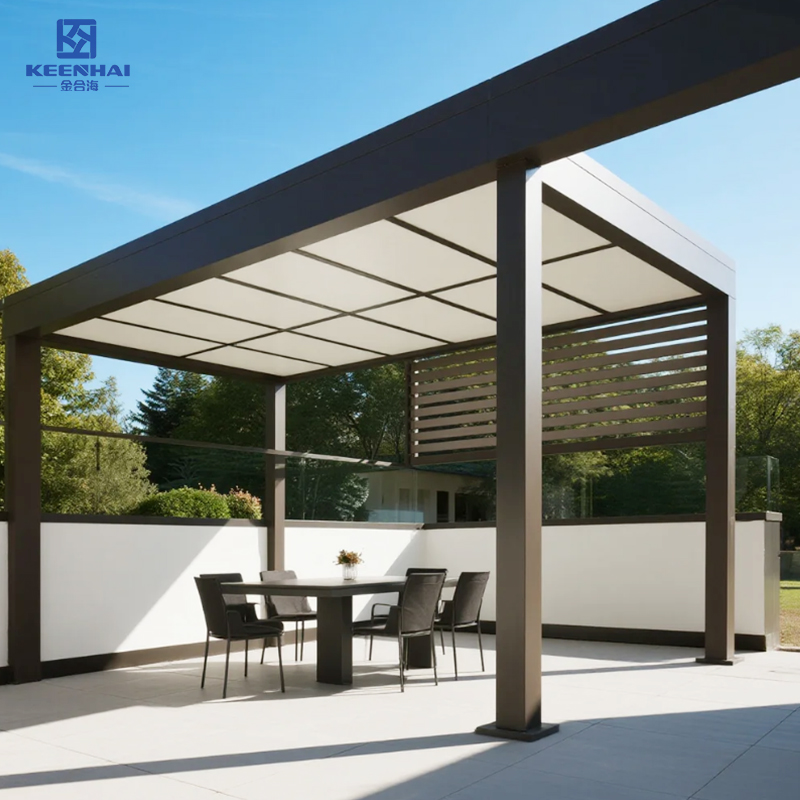
3. Assess Customization and Project Support Ability
Customization and project support determine whether a supplier can adapt a louvered pergola system to real construction constraints instead of forcing projects to fit a fixed product template. In practice, outdoor structures rarely sit on perfect foundations or within standard dimensions. The ability to customize accurately often separates project-ready suppliers from catalog-based sellers.
3.1 Custom Size, Color, and Functional Configuration Options
Effective customization starts with dimensional flexibility. Reliable suppliers support non-standard spans, variable column heights, and asymmetric layouts without compromising structural balance. This matters in residential patios where existing walls, sliding doors, or rooflines dictate exact clearance requirements rather than ideal measurements.
Color and finish options also require technical consistency. Custom colors must maintain uniform coating thickness and gloss level across beams, louvers, and columns. In mixed-use projects combining pergola systems with an aluminum automated pergola, mismatched finishes immediately expose poor batch control and weak process coordination.
Functional configuration adds another layer. Adjustable louvers, integrated lighting channels, and concealed drainage paths must align precisely within the frame geometry. Customization only works when engineering, not sales preference, defines the configuration limits.
3.2 Engineering Drawings and Technical Support for Projects
Engineering support transforms customization from a promise into a deliverable outcome. Professional suppliers provide dimensioned drawings that reflect real installation logic, including load paths, fixing points, and drainage direction. These drawings allow contractors to identify conflicts before materials reach the site.
A typical project coordination workflow includes:
-
Confirming site dimensions with tolerance ranges, not single-point values
-
Issuing revised drawings reflecting column placement and beam spans
-
Verifying motor clearances and access points for maintenance
-
Finalizing drawings only after installation sequencing aligns with site conditions
Suppliers experienced with aluminum motorized pergola systems usually document torque limits, wiring routes, and control box locations directly on drawings. This level of detail prevents last-minute adjustments that increase labor cost and delay schedules.
3.3 Experience with Residential and Commercial Installations
Project experience shapes how suppliers anticipate problems before they occur. Residential installations prioritize visual alignment, quiet operation, and minimal structural intrusion. Commercial projects, by contrast, focus on durability, repeatability, and maintenance access across multiple units.
Suppliers familiar with hospitality or mixed-use developments often apply lessons learned from Aluminum Modern Gazebo installations, such as managing larger spans and higher foot traffic loads. These experiences influence column spacing, blade reinforcement, and anchoring strategies even in smaller projects.
A supplier’s real value shows in how smoothly projects progress—not in how many options appear on a brochure. Experience turns customization into a controlled process rather than an experiment.
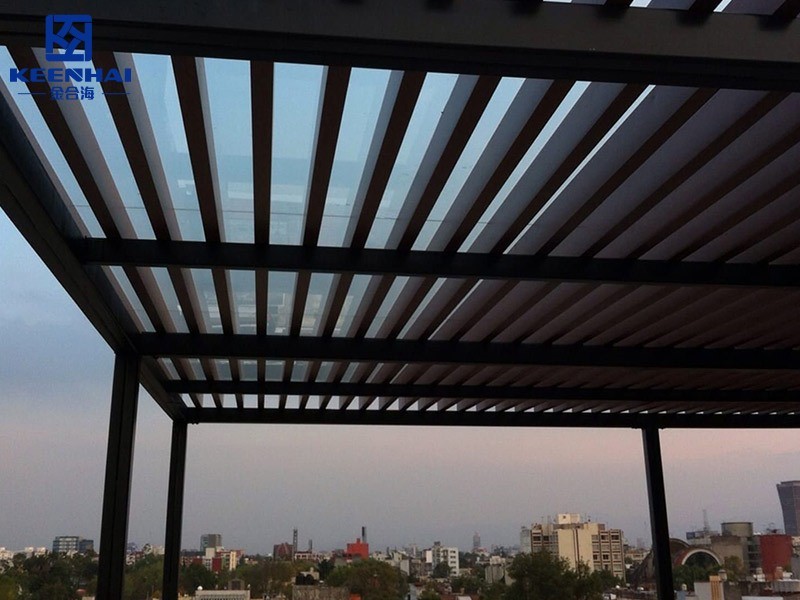
4. Compare Pricing Transparency and Quotation Structure
Pricing transparency reveals how a supplier actually operates. A clear quotation structure shows whether costs come from real production inputs or from layered markups. For any louvered pergola project, pricing clarity matters just as much as the final number, because hidden gaps often surface later as change orders or delays. A reliable supplier explains pricing logic before you ask for clarification.
4.1 Factory-Direct Pricing vs Trading Company Markups
Factory-direct suppliers price products based on material usage, fabrication time, and system configuration. Their margins stay visible and relatively stable. Trading companies, however, add markups to cover sourcing, coordination, and risk transfer, which often inflates costs without improving product quality.
In practice, the difference becomes obvious during customization. For example, projects involving an aluminum pergola house configuration often require non-standard beam lengths or reinforced columns. Manufacturers adjust pricing based on actual aluminum weight and processing steps, while intermediaries frequently apply flat percentage increases without explaining the cost driver.
| Pricing Aspect | Factory-Direct Supplier | Trading Company |
|---|---|---|
| Cost Basis | Materials + Processing | Purchase Price + Margin |
| Custom Adjustment Logic | Itemized and measurable | Often bundled |
| Price Stability | Predictable | Variable |
| Technical Justification | Clear | Limited |
Transparent pricing usually correlates with direct production control, not sales positioning.
4.2 What Is Included in a Louvered Pergola Quote
A professional quote breaks costs into functional components instead of presenting a single total. This structure allows buyers to understand value rather than negotiate blindly. A complete quotation typically includes structural framework, louvers, surface treatment, control systems, and essential accessories.
For projects using aluminum motorized pergola systems, suppliers should clearly separate motor units, control modules, and wiring components. This separation helps project managers assess maintenance exposure and future replacement costs. Quotes that hide these elements under vague labels often lead to confusion during installation or commissioning.
A detailed quote protects both sides by aligning expectations before production starts.
4.3 Cost Factors Affecting Custom Louvered Pergola Orders
Customization introduces cost variables that suppliers must manage carefully. Span width, column height, and blade length directly influence aluminum consumption and machining time. Larger spans require thicker profiles or internal reinforcement, increasing material weight per square meter.
Additional factors include:
-
Surface finish complexity, such as special colors or texture consistency
-
Control system type and usage frequency
-
Packaging requirements for long-distance shipping
-
Installation sequencing for multi-unit projects
Suppliers with real project experience explain how each variable affects pricing instead of offering unexplained totals. When cost drivers align logically with design choices, pricing becomes predictable rather than negotiable.
5. Confirm After-Sales Support and Long-Term Cooperation
After-sales support determines whether a supplier remains a partner after delivery or disappears once payment clears. For any louvered pergola project, long-term cooperation matters because outdoor systems operate daily and face weather, mechanical wear, and usage changes over time. Reliable suppliers plan for post-installation service before problems occur.
5.1 Warranty Coverage for Structure and Motor Systems
Warranty terms reflect how confident a supplier feels about its own products. Structural warranties typically cover aluminum frames, load-bearing components, and coating performance, while motor warranties focus on operational cycles and electrical reliability.
In projects using aluminum motorized pergola systems, warranty clarity becomes critical. Suppliers should specify coverage duration separately for structure and motors rather than grouping everything under a single term. This separation allows buyers to assess risk accurately, especially in high-frequency usage environments such as hospitality terraces or shared residential spaces.
5.2 Replacement Parts Availability and Technical Response Speed
Even the most reliable louvered pergola systems require maintenance over time, especially motorized or automated setups. Having readily available replacement parts is critical to avoid prolonged downtime and keep outdoor spaces functional. Suppliers who maintain an organized inventory of components—motors, control modules, louvers, and fasteners—can address issues faster than those sourcing parts on demand.
A practical support workflow usually follows these steps:
-
Identify the issue through on-site inspection or clear photo documentation.
-
Verify the affected component against batch numbers or system revisions to ensure compatibility.
-
Confirm availability in the supplier’s stock or schedule production if a replacement is needed.
-
Ship and coordinate installation, minimizing operational disruption.
Choosing a supplier with stocked components and rapid technical support, like KeenHai Pergola, ensures that any maintenance or part replacement happens quickly, keeping your outdoor environment safe and fully functional. Suppliers who can demonstrate documented response times and organized spare part storage show that they understand real-world project needs, not just product sales.
5.3 Supplier Stability for Ongoing Projects and Repeat Orders
Long-term cooperation requires organizational stability. Suppliers involved in multi-phase developments or repeat residential projects must maintain consistent production standards over time. Changes in material sourcing, coating suppliers, or motor brands can disrupt compatibility between earlier and later installations.
Suppliers who support repeated installations—such as residential expansions or phased outdoor upgrades—often apply lessons learned from Aluminum Modern Gazebo projects, where long service life and replacement continuity play a key role. This experience helps maintain visual and functional consistency across years, not just across one shipment.