
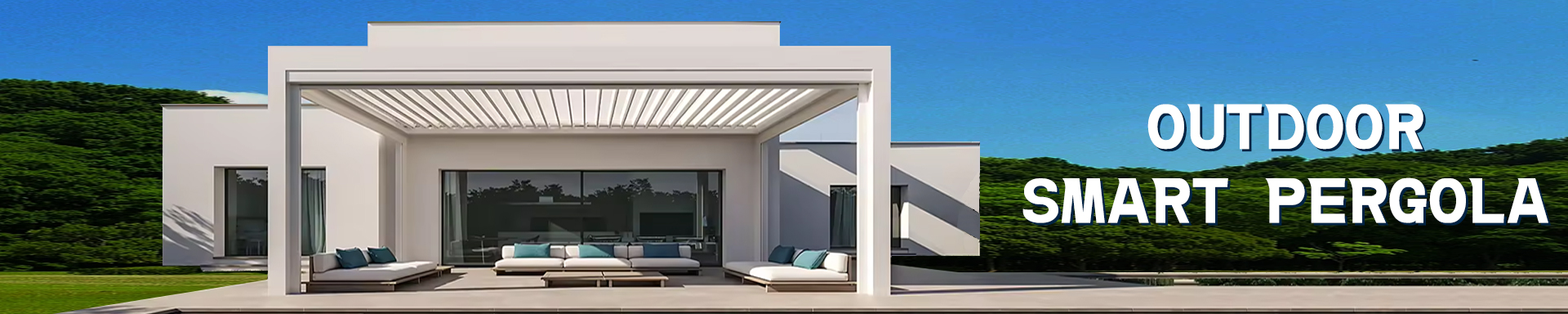
1. What Is a Louvered Pergola
A modern louvered pergola system is an outdoor structure built around a roof made of adjustable horizontal louvers, rather than a fixed solid or slatted top. These louvers rotate in unison to control sunlight, airflow, and rain exposure with precision. Unlike decorative shade frames, a true louvered pergola functions as an active environmental control system for outdoor spaces, not just a visual feature.
For residential terraces, villas, and commercial patios, this type of structure allows users to fine-tune comfort throughout the day while maintaining an open-air feel when conditions permit. In many contemporary projects, architects specify a louvered pergola system as part of the building envelope rather than treating it as loose outdoor furniture.
In real projects, you often see these systems integrated into aluminum pergola house designs where the pergola aligns with sliding doors, outdoor kitchens, or poolside lounges. The structure visually extends interior space outdoors while remaining functional in changing weather, which explains why louvered systems now replace traditional pergolas in many climate-sensitive regions.
1.1 Definition and Core Concept
At its core, a louvered pergola consists of three functional elements working together:
-
Adjustable louvers that rotate from fully open to fully closed, typically between 0° and 135°.
-
A rigid load-bearing frame, most commonly aluminum, engineered to handle wind and rain loads.
-
An integrated drainage path that channels water away when the louvers close.
What separates this concept from basic pergolas is control. Users decide how much sun enters, when airflow passes through, and how rainwater exits the structure. In high-end residential builds, this concept often appears in automated formats such as an aluminum automated pergola, where motors synchronize louver movement with weather conditions.
From a usage perspective, this design works especially well in courtyards, rooftop terraces, and hospitality patios where conditions shift rapidly throughout the day. Instead of leaving or adding temporary covers, users simply adjust the roof to match the moment.
1.2 How a Louvered Pergola Differs from a Fixed Pergola
The key difference between a louvered pergola and a fixed pergola lies in functional adaptability. A fixed pergola offers constant shade or partial cover, while a louvered system actively responds to environment and user intent.
| Feature | Louvered Pergola | Fixed Pergola |
|---|---|---|
| Roof adjustability | Louvers rotate to control sun and rain | Static beams or panels |
| Weather response | Can close fully during rain | Requires external cover |
| Airflow control | Adjustable ventilation through louvers | No airflow adjustment |
| Daily usability | Suitable from morning to night | Limited by sun angle |
| Integration potential | Works with motorized controls | Purely structural |
In practice, this difference becomes obvious in real settings. For example, a restaurant terrace using an aluminum motorized pergola can remain operational during light rain, then reopen the roof once conditions improve. In contrast, a fixed pergola either blocks light all day or fails to protect guests during sudden weather changes.
This adaptability also explains why designers often choose louvered systems over fixed gazebos when planning modern outdoor zones. Even when visual styles overlap with concepts like an aluminum modern gazebo, the functional behavior remains fundamentally different: one adapts, the other does not.
2. Main Structural Components of a Louvered Pergola
A louvered pergola is not a decorative frame with a moving roof; it is a mechanically coordinated structure where each component affects performance. Roof movement, structural stability, and water control operate as a single system. If any component lacks precision, the entire pergola loses reliability in real outdoor conditions such as wind uplift, heavy rain, or thermal expansion.
From an engineering standpoint, the structure consists of three core subsystems: the adjustable louver roof, the load-bearing frame, and the concealed drainage network. Each one serves a distinct function, yet they must remain dimensionally aligned to avoid long-term deformation or leakage.
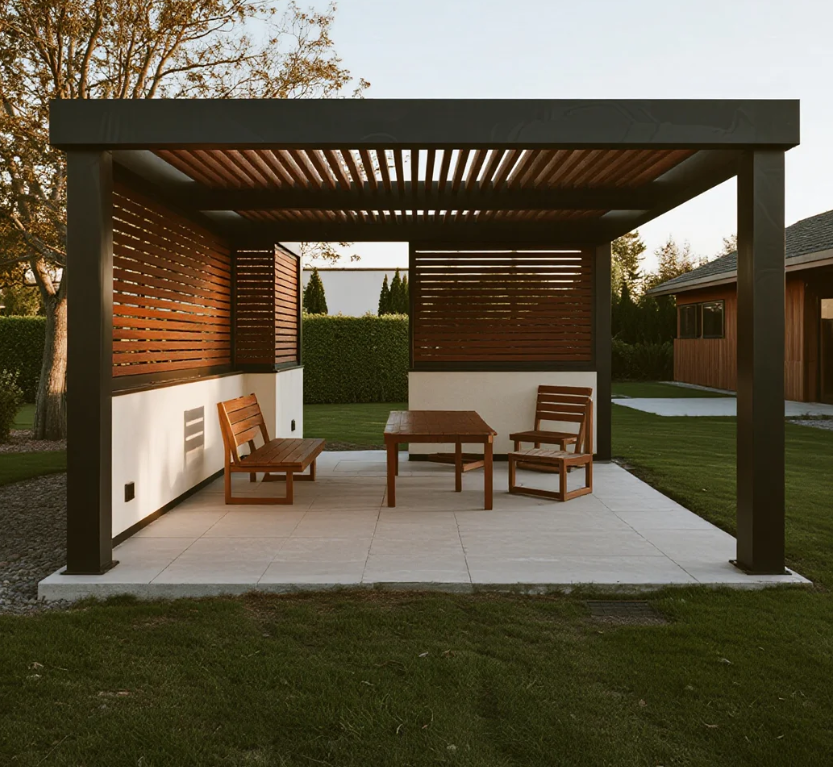
2.1 Adjustable Louver Roof System
The adjustable louver roof acts as the functional center of the system. Each louver typically forms from extruded aluminum profiles with internal reinforcement ribs to prevent bending over long spans. The rotation mechanism connects all louvers through a synchronized linkage, ensuring uniform angle changes rather than uneven movement.
In practice, louvers operate within a defined rotation range to balance sunlight, airflow, and rain protection:
| Parameter | Typical Range |
|---|---|
| Louver rotation angle | 0°–135° |
| Single louver width | 120–200 mm |
| Aluminum wall thickness | 1.2–2.0 mm |
| Wind resistance rating | Up to Beaufort scale 10 |
Precise angle control matters more than full closure. At partial angles, louvers block direct solar gain while still allowing hot air to escape upward, which explains why architects favor adjustable systems in hot climates rather than fixed roofs.
In premium projects, this roof integrates directly with motorized control units, such as those used in an aluminum motorized pergola. The motor does not “force” the louvers; instead, it applies consistent torque through calibrated gearboxes to avoid stress concentration at pivot points.
2.2 Frame, Posts, and Load-Bearing Structure
The frame defines how much structural load the pergola can safely manage. Vertical posts transfer roof loads to the foundation, while perimeter beams resist lateral forces caused by wind and louver rotation.
Experienced installers focus on three structural priorities:
-
Post alignment – Even minor angular deviation causes long-term louver friction.
-
Beam cross-section depth – Deeper profiles reduce deflection over wider spans.
-
Thermal expansion gaps – Aluminum expands measurably under heat; the frame must allow controlled movement without loosening joints.
A rigid frame does not mean overbuilt. Excessive material increases weight and thermal stress without improving performance. Balanced structural design keeps the roof responsive while maintaining long-term dimensional stability in outdoor conditions.
2.3 Integrated Drainage Channels
Water management defines whether the structure functions as a true weather system or fails during rainfall. When the louvers close, their geometry directs water toward internal gutters concealed within the beams rather than allowing runoff at the edges.
A properly designed drainage path follows a clear sequence:
-
Rain lands on closed louvers and flows toward their longitudinal edges.
-
Water enters side channels integrated into the perimeter beams.
-
Vertical downpipes hidden inside posts guide water to ground-level outlets.
The drainage system must remain invisible yet oversized enough to handle sudden rainfall. Undersized channels cause overflow during heavy storms, which leads to staining on surrounding surfaces and user complaints. In professional projects, installers always test drainage flow rates on-site before final handover, especially in regions with short, intense rain events.
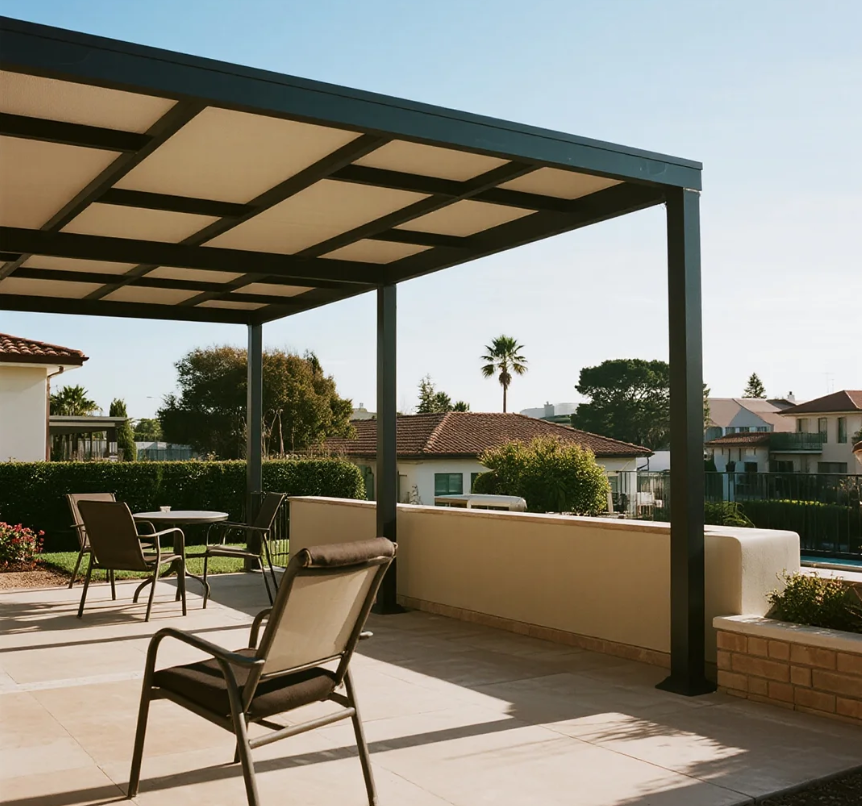
3. How a Louvered Pergola Works
A louvered pergola works by coordinating rotation geometry, gravity-driven drainage, and pressure-based airflow into a single responsive system. Instead of relying on static shade or add-on covers, the structure adjusts its roof position to match real-time environmental conditions. The effectiveness does not come from movement alone, but from controlled movement within defined mechanical limits.
From daily residential use to commercial outdoor dining, this working principle allows the space to remain usable across changing sunlight angles, sudden rainfall, and heat buildup.
3.1 Louver Rotation and Sunlight Control
Louver rotation determines how much solar radiation reaches the space below. Each louver pivots along its longitudinal axis, changing the incident angle of sunlight rather than blocking light entirely. This distinction matters, because controlling glare and heat gain requires precision, not full shade.
In practical applications, users adjust louvers according to time of day:
| Sun Position | Typical Louver Angle | Resulting Effect |
|---|---|---|
| Morning (low angle) | 20°–40° | Blocks glare while preserving brightness |
| Midday (high sun) | 80°–100° | Reduces direct heat gain |
| Late afternoon | 30°–60° | Softens light without darkening space |
The key advantage lies in incremental control. Instead of choosing between “open” or “closed,” users fine-tune comfort minute by minute. In automated setups, calibrated motors execute these adjustments smoothly, a principle widely applied in aluminum automated pergola systems where torque limits prevent sudden mechanical stress.
3.2 Rain Management and Water Flow Direction
When rain begins, the system shifts from light control to water management. Louvers rotate into a closed position, forming a continuous surface with overlapping edges. This geometry directs water inward rather than outward, preventing edge dripping.
The water flow follows a predictable sequence:
-
Rain hits the closed louvers and moves along their angled surfaces.
-
Side channels within the roof beams collect the runoff.
-
Vertical paths inside the posts guide water to ground-level outlets.
This process relies entirely on gravity and slope accuracy, not seals or membranes. If the louver angle or beam alignment deviates even slightly, water pools instead of flowing. That is why experienced installers always verify slope tolerances during setup rather than relying on factory defaults.
3.3 Airflow Regulation Through Adjustable Louvers
Airflow control defines everyday comfort, especially in warm climates. When louvers open partially, they create pressure differentials that pull warm air upward while drawing cooler air laterally through the space. This passive ventilation reduces heat buildup without mechanical fans.
In real-world terrace projects, users typically adopt three airflow modes:
-
Fully open – Maximum ventilation during mild weather.
-
Partially open – Balanced shade and airflow during peak heat.
-
Nearly closed – Controlled ventilation during light rain or wind.
Unlike fixed roofs, adjustable louvers allow airflow without sacrificing coverage. This capability explains why designers prefer these systems for outdoor kitchens, poolside lounges, and dining areas where heat and moisture accumulate quickly.
4. Control Systems Used in Louvered Pergolas
Control systems determine how precisely users interact with a louvered pergola in daily use. While the structural components define capability, the control method defines experience. In real projects, the choice between manual, motorized, or sensor-driven control affects adjustment speed, long-term reliability, and how often users actually change roof positions instead of leaving them static.
A well-matched control system ensures that roof movement remains smooth, predictable, and mechanically balanced, even after thousands of operation cycles.
4.1 Manual Operation Mechanisms
Manual control relies on mechanical linkages, typically a hand crank or lever system connected to the louver rotation shaft. This setup transfers rotational force directly to the louvers without motors or electronics.
From an installation standpoint, manual systems follow a clear logic:
-
The operator applies rotational force through the handle.
-
A gearbox amplifies torque to rotate the louver shaft evenly.
-
All louvers move in synchronized angles through mechanical arms.
Manual systems excel in simplicity. They suit compact patios, low-frequency use areas, and projects where power supply remains limited. However, physical effort increases with roof size, which explains why manual control rarely appears in spans exceeding standard residential dimensions.
4.2 Motorized and Remote-Controlled Systems
Motorized control replaces physical input with calibrated electric motors integrated into the beam or roof assembly. These motors apply consistent torque across the entire louver set, preventing uneven rotation that leads to long-term wear.
In practical use, motorized systems operate through:
-
Wall-mounted switches for fixed locations.
-
Remote controllers for flexible operation.
-
App-based interfaces for programmable positions.
Consistency matters more than speed. High-quality motors rotate louvers gradually to avoid sudden load transfer. This principle defines systems used in an aluminum motorized pergola, where precise control preserves alignment even under frequent daily adjustments.
From a user perspective, remote control dramatically increases how often people fine-tune roof angles instead of leaving them fully open or closed all day.
4.3 Sensor-Based Automatic Adjustments
Sensor-driven control adds environmental feedback to motorized systems. Rain, wind, or sunlight sensors trigger predefined louver positions without user input, ensuring fast response during sudden weather changes.
The automation sequence works as follows:
-
Sensors detect environmental thresholds such as rainfall or wind speed.
-
The controller evaluates preset conditions.
-
Motors adjust louvers to protective or ventilated positions.
Automation does not remove user control; it prioritizes protection. Users can still override settings manually, but the system reacts instantly when conditions change unexpectedly. This logic forms the foundation of an aluminum automated pergola, commonly specified for restaurants, rooftop terraces, and unattended outdoor areas.
In real-world applications, automation reduces operational errors and prevents damage caused by delayed reactions to sudden weather shifts.
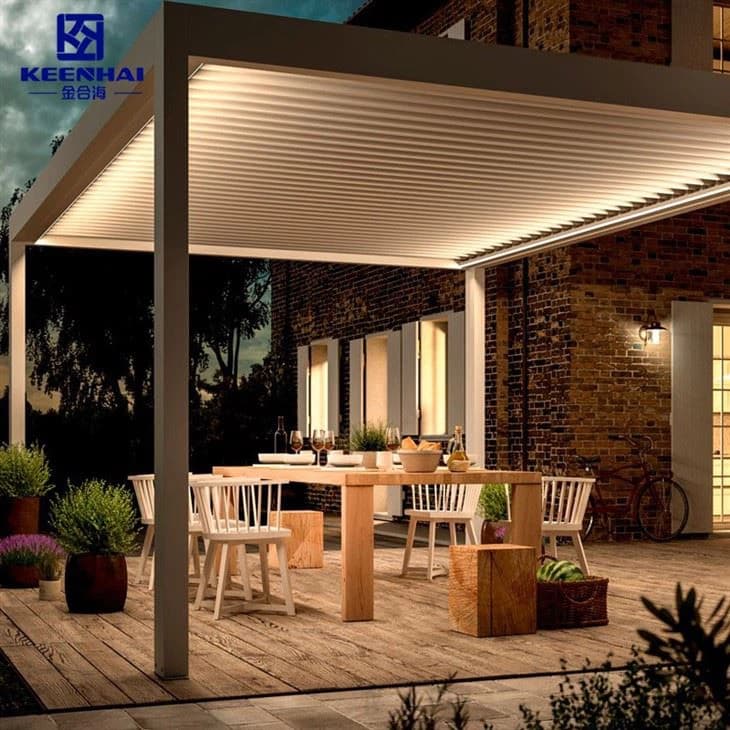
5. Functional Performance in Different Weather Conditions
A louvered pergola proves its value only when weather conditions change. Sun, rain, and wind stress the structure in different ways, and each condition tests a specific aspect of design accuracy. Performance depends on angle control, drainage geometry, and pressure management, not on material thickness alone.
5.1 Operation in Full Sun and High-Temperature Environments
In strong sunlight, the system focuses on solar control rather than full shading. By adjusting louver angles, users block direct radiation while allowing reflected daylight to enter, which keeps the space usable without creating a closed, overheated zone.
In real outdoor living projects, users typically follow this adjustment pattern:
-
Set louvers between 80°–100° during midday to block vertical sun.
-
Reduce angles to 30°–60° in early morning or late afternoon to soften glare.
-
Open louvers fully once ambient temperature drops to release trapped heat.
Angle precision directly affects surface temperature and perceived comfort. Field measurements on aluminum systems show that controlled shading can lower perceived temperatures by 6–10°C compared to fixed open pergolas under identical sun exposure.
| Roof Configuration | Surface Heat Accumulation | User Comfort Level |
|---|---|---|
| Fixed open pergola | High | Low |
| Fixed solid roof | Very high | Moderate |
| Adjustable louvers | Controlled | High |
5.2 Performance During Rainfall
Rain performance depends on closure accuracy and drainage continuity, not on waterproof coatings. When rain begins, users rotate louvers into a closed position to form a continuous sloped surface.
The rain-handling sequence works as follows:
-
Louvers close and align edge-to-edge.
-
Water flows along louver channels toward perimeter beams.
-
Internal gutters guide runoff into vertical downpipes.
-
Water exits at ground level away from foot traffic zones.
The critical factor lies in alignment tolerance. Even small installation errors disrupt flow paths and cause dripping at joints. Experienced installers always verify closure uniformity on-site before final acceptance, especially in regions with sudden heavy rainfall.
5.3 Ventilation Behavior in Windy Conditions
Wind introduces both opportunity and risk. When managed correctly, airflow improves comfort; when ignored, it creates uplift forces and vibration.
Users adapt ventilation behavior through controlled louver positioning:
-
Open louvers partially to allow pressure equalization.
-
Avoid fully closed positions during strong crosswinds unless rain demands it.
-
Adjust angles to redirect airflow upward instead of horizontally.
Controlled airflow prevents heat buildup without amplifying wind force. Unlike fixed roofs, adjustable louvers allow pressure release, which reduces structural stress during gusts. This behavior explains why designers specify adjustable systems for coastal or elevated locations where wind conditions change rapidly.